Our Icons
We are blessed to have many original icons in our sanctuary. This page gives you information on the two large icons at the front of the sanctuary.

(Click on the icon to make it large so you can better see the details.)
St. Richard’s icon installation in the Lady Chapel was “written” by Katerina Tsigas Papaioano, Sayaka Kamakari, and Cindy Borr. Katerina, resident artist at St. Richard’s Icon Guild, was commissioned to create the Icon, a memorial gift. The icon depicts the Archangel Gabriel, the Virgin Mary "Holy Protection," Jesus Christ, Saint Mary Magdalene, and the Archangel Michael. Click here for information on icon artist Sayaka Kamakari. The icon was commissioned by Scott Wilson, who gave it to the parish in memory of his parents, Herbert and Frances B Wilson.
An icon is not just art or a pretty picture. Its purpose is to aid us in prayer and draw us closer to God. Photios Kontoglou, the renowned modern iconographer, expressed this perfectly: "Icons raise the soul and mind of the believer who sees the icon to the realm of the spirit, of the incorruptible, of the kingdom of God, as far as this can be achieved with material means."
The Archangel Gabriel is holding a horn and a lily. The lily is a symbol for the Virgin Mary. Gabriel is a messenger from God, chosen by God to announce salvation to humanity. He appeared to the Virgin Mary to tell her she would carry the son of God. The horn he is holding symbolizes sound and wind. He will blow the horn to announce the Judgment Day and the Lord’s return to earth. He is the angel of clarity, purity, and joy. The ribbons that hold the angels head piece, curl near their ears representing divine hearing and attentiveness to the will of God.
The Virgin Mary and Jesus Christ are the only ones with Greek symbols. The symbols around Mary are ΜΠ ΘY, which is short for Μητερ Θεου (“Mother of God”). The symbols for Jesus areIC XC, which are the reduced form of the name Jesus Christ.
IC
is the shortened form of Jesus and
XC
is the shortened form of Christ. The symbols on the halo are the Greek word O Ѡ N, which means “I AM” (the divine name revealed to Moses in the burning bush, “I am Who I am” in Exodus 3:14. Even the colors are significant in an icon. Here, the Virgin Mary and Jesus are in opposing colors of red and blue. Red signifies heaven and royalty, and blue signifies earth. Christ has red on the inside because He came from heaven and blue on the outside because He came down to earth. Mary is the opposite because she’s from earth, but went up to heaven. His fingers form the letters I, C, X, and
C, so He is blessing us in the name of Jesus Christ. He is holding a Bible to symbolize that He is giving us His word through the Bible. The Bible is open to the scripture, “I am the light of the world. Whoever follows me will never walk in darkness but will have the Light of life.” (John 8:12)
Mary’s name here is “Holy Protection,” which is one of her titles (“Agia Skepi”). Agia Skepi has a complex meaning. It refers to the cloak or the shroud, but it also means protection and intercession. Her hands are open in prayer for us toward God. She is interceding for us as she covers us with her holy veil. She has three stars on her head and shoulders to remind us she was a virgin before, during, and after the birth of Jesus.
According to all four gospels, Mary Magdalene traveled with Jesus as one of his followers, and was a witness to His crucifixion and resurrection. She is mentioned by name 12 times in the Bible, more than most of the apostles! Here, she is holding a jar, a reference to her appearance in John 12:1-8 where she anointed Jesus’ feet with oil and dried them with her hair.
As God’s warrior, the Archangel Michael is depicted in his armor holding a sword. His cape is red, which symbolizes victory. Michael is the commander of all the angels and the guardian of the church. He fights against evil on this earth and for all of us.
An icon has no directional light source. The light comes from within the saints. Icons do with image and color what Scriptures do with words. The eyes are large and animated because they’ve seen the things of heaven. The ears are large because they’ve heard the commandments of the Lord. The ears are attentive to the Lord as they shut out the noise of this world. Noses are long and thin to remind us of spiritual fragrances. The mouths are made small to remind us of humility and fasting. The neck is pronounced and full of the breath of God. Christ and the saints didn’t say very much, but when they spoke it was very profound and very divine. The lower background is painted in the same blue as the seats in the church to give us the feeling that they are here with us.
There are many stars on the background of the icon. The writers wanted the design of the icon to be enfolded into the beauty of St. Richard’s. The stars reference Betty Wolf’s banner book. Betty was the artist who created all of the banners at St. Richard’s. The stars around each of these icons have special meaning. The four-pointed star symbolizes the cross and the Star of Bethlehem. The six-pointed star, the Star of David, is representative of God reaching down to humans and humans reaching up to God – the union of heaven and earth. The seven-pointed stars are for the gifts of the Holy Spirit: wisdom, piety, understanding, counsel, fortitude, knowledge, and the fear of the Lord. The eight-pointed star tells of rebirth and regeneration and has been a symbol of baptism for more than 2,000 years. It represents resurrection, salvation, and abundance. The nine-pointed star represents the fruits of the spirit: love, joy, peace, forbearance, kindness, goodness, faithfulness, gentleness, and self-control."
Click here to download a PDF copy of this description.
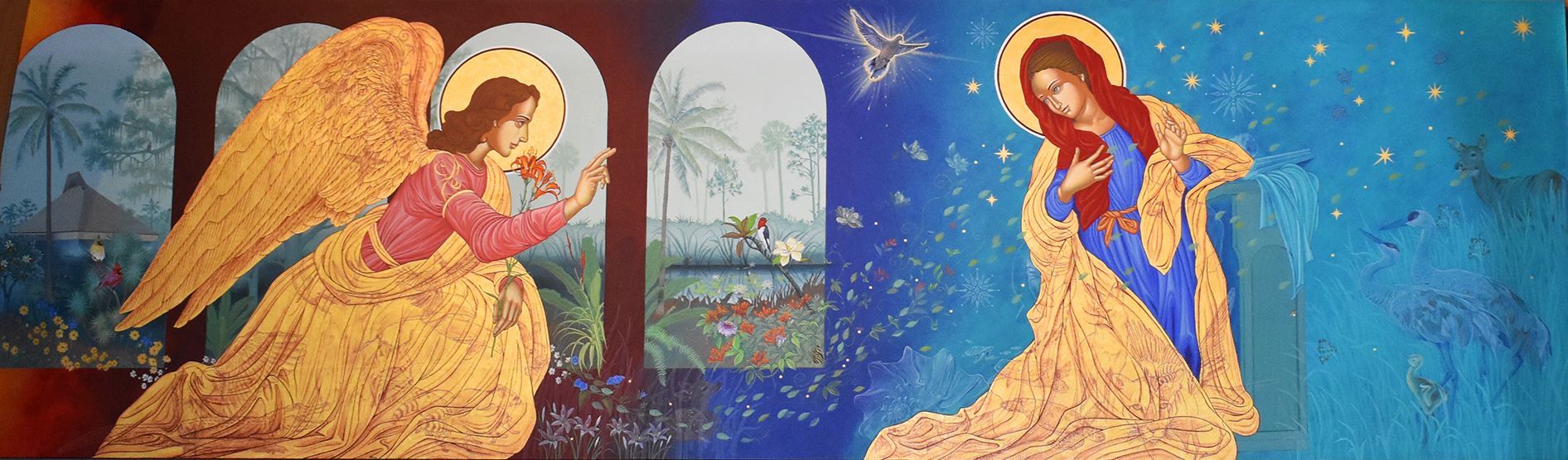
“The Annunciation in the Florida Wilds”
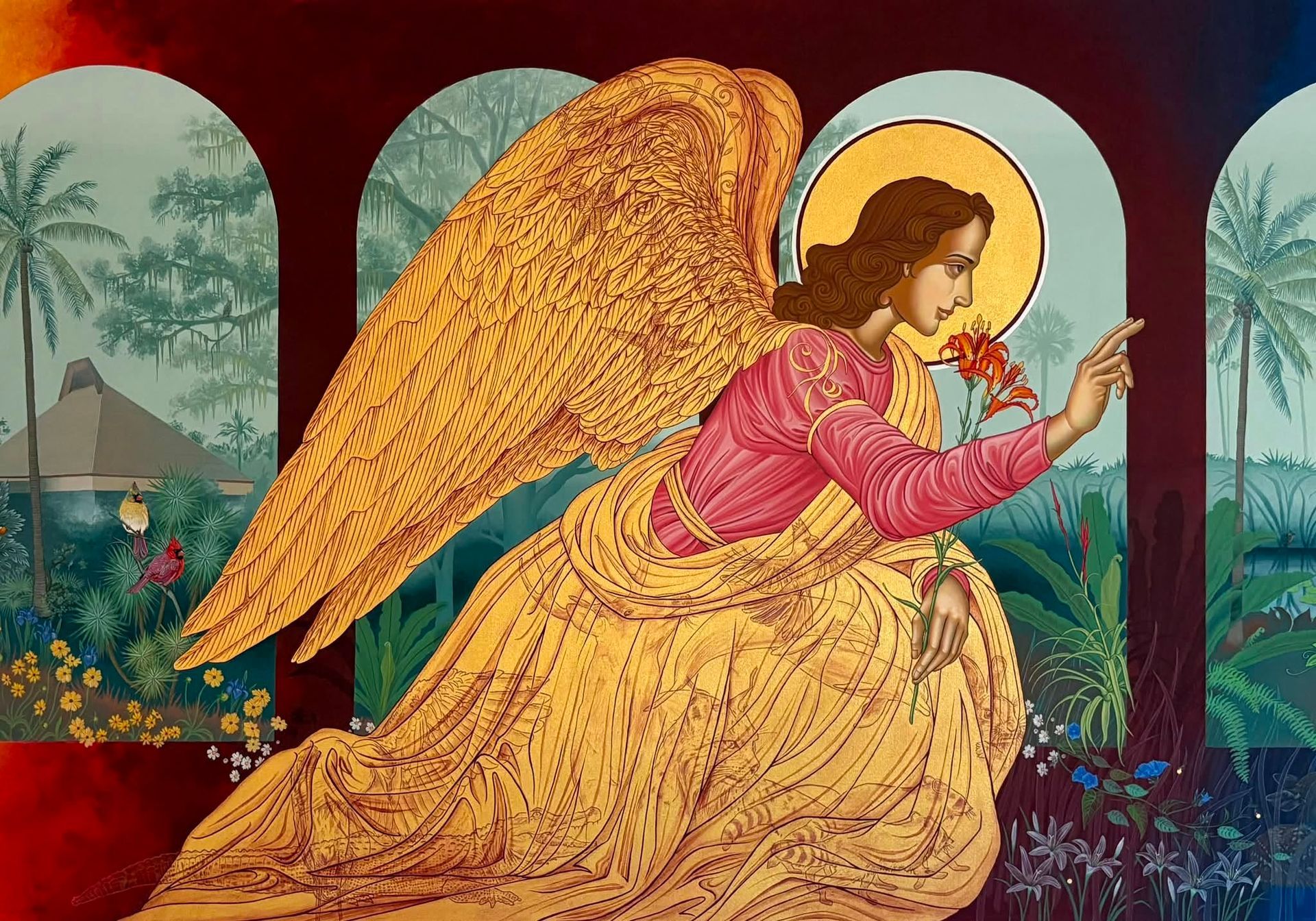
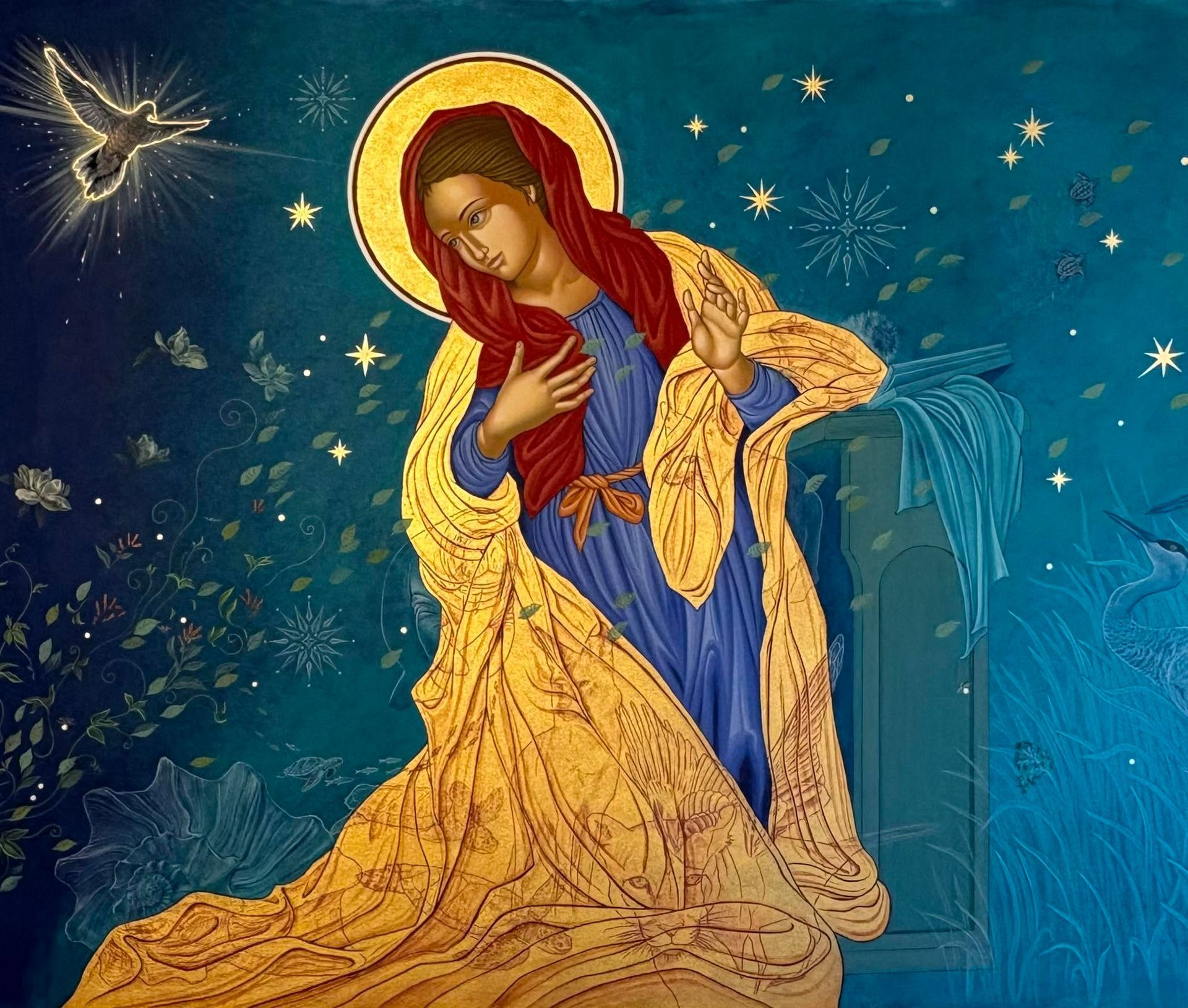
East Meets West: This mural is a dialogue between the timeless, symbolic spiritualism of the Byzantine East and the narrative drama of the Latin West. These styles were unified within a Florida landscape.
The Gospel of Luke provides the spiritual core of the mural. In Luke 1:26–38 (The Annunciation) the moment of divine encounter is seen in Mary’s expression reflecting both her solemn resolve and her humble acceptance. In Luke 1:46–55 (The Magnificat) we see Mary’s song of praise. The joy and profound awakening found in these verses resonate through the vibrant Florida landscape surrounding her.
Across the canvas, (accompanied by Florida’s mourning dove, representing the Holy Spirit), a divine breeze flows from the feet of the Archangel Gabriel toward the Virgin Mary. Vines and leaves dance in the air, caught in a motion that suggests the natural world is responding to a sacred presence. Throughout the mural, the semicircular arch—a hallmark of Early Christian, Byzantine, and Romanesque architecture—serves as a recurring visual anchor.
From Everglades to Hammock: The background provides a rich, botanical foundation for the sacred narrative. This landscape is not a single location, but a harmonious blend of Florida’s diverse terrains.
Among the native species including several endangered species, see if you can find the following
Florida’s Sacred Fauna Florida Panther “State Animal,” Bobcat, Florida Black Bear, Red-headed Woodpecker, Florida Scrub Jay, Northern Mockingbird, Great Blue Heron, Northern Cardinal, Florida Sandhill Crane, Ruby-Throated Hummingbird, Great Horned Owl, Mourning Dove, Gray Squirrel, Cottontail Rabbit, Marsh Rabbit, White-tailed Deer, Northern Raccoon, Coyote, Gray Fox, Alligator, Gopher Tortoise, Manatee, Loggerhead Sea Turtle, Bottlenose Dolphin, Horse Conch, King Mackerel
Florida’s Sacred Flora Cabbage Palm, Coconut Palm, Live Oak, Spanish Moss, Leatherleaf Airplant, Slash Pine, Longleaf Pine, Saw Palmetto, Sand Live Oak, Spanish Bayonet, blossoming Orange Tree, Southern Magnolia, “Passion Flower,” Firebush, White Waterlily, Duck potato, Duckweed Sawgrass, Sword Fern, Bird’s-nest Fern, Pine Lily, Leavenworth's Tickseed, Florida Tickseed, Spanish Needles, Prairie Blueflag, Atamasco Rain Lily, Sky Blue Clustervine, Coral Honeysuckle, Queen Palm
Florida’s Sacred Insect Passion Butterfly, Zebra Longwing, Everglades Brownwing Firefly, Common Eastern Bumblebee, Spotless Ladybug, Convergent Ladybug
The writer of the mural is Sayaka Kamakari. It was a gift from Scott Wilson in gratitude for St. Richards parish. You can access Sayaka's webpage at https://sayaicons.com.